Friday, 26 August 2011

Sooty Falcon Survey- Part One


In the last couple of months Darren has been updating the blog with summer birding manly during ringing operations here in Sde Boker. While He was jollying here I was busy running Birding Camps for children and preparing for some of the future activities. Trying to set up a Birding Center can be a little demanding and can mean not as much time as one wishes in the field.
Lucky for me, one of the tasks we set for this year was to study the current distribution of the Sooty Falcon, Falco concolor, one of the Negev specialties. So that means back to the field!
In order to do that, we decided to look back at previous breeding surveys. With the help of the IOC (Israel Ornithological Center) and NPA (Nature and Parks Authorities) we got hold of history breeding data and soon realized that information was pretty much undecided. Until the late 70's the Sooty Falcon was treated as a rare breeder in The Judean Desert and Eilat. A first survey showed that the species is more common than thought and a raptor survey conducted in 1980-84 suggested a population size of 70-100 pairs all over the deserts of Israel . But indication were made that lots of potential sites haven't been checked. Since then local counts have been conducted but no general population estimations have been done. The Sooty Falcon arrives back from his wintering grounds in Madagascar and southern Africa in April-May. It raises the chicks in autumn, timing it exactly to the peak of the bird migration (August-October). A study on some of the pairs breeding near Sde Boker showed that 95% of its diet is based on migratory birds. By late October all the birds have gone their way back to Africa.
We divided the Negev to different geographic areas and marked all the historical known nests in each and every one of them. Looking at the nests distribution we decided to focus on two areas which consisted most of the breeding sites even though some of them haven't been studied therally; the Cliffs of Zin River and the area east of Ramon Crater. These areas are vast, containing huge cliffs, all potential breeding sites for the Sooty Falcon. The way to do it, we learned, was to spend as much time as possible in the area, no short- cuts! After two weeks of working the Zin Cliffs, covering most of the cliffs we found four definite breeding sites and three potential ones. We've decided to return to this area later when the chicks will be older and noisier, hence easier to spot.
Encouraged by these results we set for our very big challenge; East of the Ramon Area. While the Zin Cliffs are pretty easy to reach by a normal private car, the Ramon-East area is very remote and can be reached only by 4X4b vehicles. If we want to find the birds we need to spend time there, mainly mornings and evening which means camping for at least two nights… Life is hard.

So off we went! Barak and I were joined by Tomer from Hazeva Field School and Yael. Scanning in the evenings and hiking during the days, especially mornings (day temperatures exceed the 40c°), we found at least 3 pairs with a potential fourth. On the second day during our lunch break a pair of Sooties was air-displaying along with an immature bird (probably 2nd yr) above our heads, so close we could actually hear the wwwooosshhh as they cut through the hot air. After that they sat 20m above our heads and cleaned themselves, beautiful!! We couldn't help but wonder if this second year bird has migrated all the way from southern Africa or stayed here after fledging last year, interesting.
Camping in this stunning part of the country was absolutely a pleasure. Barak learned the secrets of the pojke and we all learned a thing or two about the gorgeous Sooties and how to find them. Apart from them we had a nice wildlife list; Sinai Agama Agama sinaita, Ibex, Hyrax, Golden Spiny Mouse, Brown Hare, Sinai Rosefinch, two pairs of Egyptian Vultures and about 300 White Storks.
This survey is still ongoing and we have plenty of work ahead of us. I'll keep updating about our progress here in our blog .
I want to thank NPA's Ben and Yoram for logistic support.
Meidad

Tuesday, 9 August 2011

Orpheans in the Undergrowth

the last week i have moved by to the pistachio plot, where i have ringed approximately 60 birds, half of these have been Eastern Orphean warblers, of which all but one have been youngsters.the youngsters leave the breeding grounds before the adults who hang around to do a bit of moulting, see the sites, relax on the Med islands etc. The adult i caught showed typical suspended moult of the 3rd and 4th secondaries.

Juv Orphean warbler with dark brown eye

Juv wing with moulted inner greater coverts

Adult bird with light eye

Adult wing with 3rd and 4th secondary unmoulted
Other highlights this week have included a Great grey shrike and a Hoopoe.

Hoopoe

Great grey shrike


Monday, 8 August 2011

Mt Hermon


i was recently lucky enough to join some of Israel's top ringers and a thoroughly nice bunch of chaps and lassies they are too. i managed a couple of ringing ticks, (rock bunting, and rock sparrow) and got to ring a number of other species that are not so common down here in the desert. here's a few images from a great weekend.

Rock sparrow

Rock nuthatch

Rock bunting

Rock tits!! (great and sombre)


Tuesday, 26 July 2011

Turkish Delight

in May i trapped my first ever foreign ringed bird. a garden warbler JA98286 which was first caught on the 23 august 2010 at the Kızılırmak Cernek Ringing Station, Kızılırmak Delta, Samsun Turkey. A distance of  1195 km, although we know it had travelled much further as  i caught it on its way back to europe after wintering in southern africa. This was also the first ever garden warbler control for Israel.
I also recently had my first ever control of one of my ringed birds. a 2cy reed warbler was caught in lake Yerocham the grand total of 22km away, where it most likely went to breed and maybe originated from there. the lake is directly east of my site, so how did this bird know how to get there! migration is a fascinating subject and one we know so little about.

ibex problem!!!

What's the most unusual thing you have had in your nets? i've had numerous bats, a gerbil, a kid on a pushbike and during the ringing demo's this month ibex, fortunately i have not had to extract them as when one of these beasts hits the net, it makes a big hole! i cannot say i have enjoyed the past months ringing as i'm on edge constantly checking where the ibex are, but most the youngsters that have attended the sessions seemed to have gone away happy even if they did have to get out of their beds early. It has also given me a chance to ring quite a number of breeding species such as bulbul and bush robins and to ring a small number of blackstarts which we only catch occasionally in our usual ringing plot. I also caught only my second ever pale rock martin which flew into a net as it was being lowered.
the first migrants have also started to appear this month with a number of olivaceous warblers and a female eastern orphean warbler being caught, along with me seeing a phylloscopus warbler on my way to work this morning. If just those damned ibex would disappear this would be a terrific little location as it's one of the most scenic ringing spots in the world.


Wadi Zin


Ibex

Tuesday, 5 July 2011

New Site

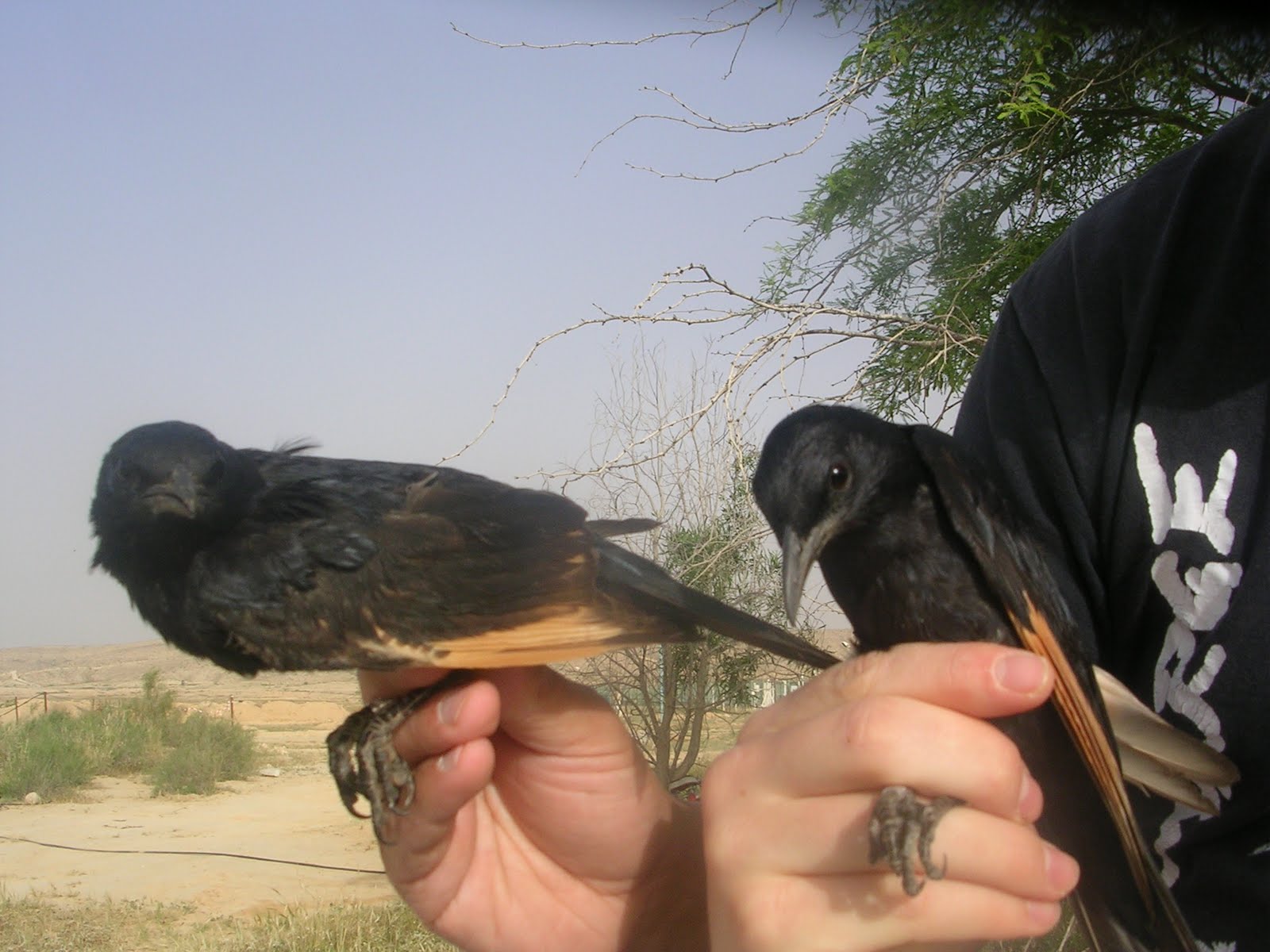
with lots of demonstrations booked for july and no birds inside the pistacchio plot, i had to try somewhere new, but still inside the village. So it was off to Ben Gurions burial site, which has a nice little park attached to it. ringing used to be good here until all the tamarix was removed. along with eran we put up 6 nets, and relaxed to watch the sun rise over the Zin wilderness, well that was what we hoped but along came the ibex and we had to constantly watch the nets too make sure we didnt trap an unwanted species as i would imagine they would make a fine mess. birds here where still few and far between. but we did manage a couple of bush robins, one of which had recently fledged along with his dad, its mom was a bit wiser and sat on top of the net before flying off. Then when i was coming back from a net round i saw Meidad, who finally made it by 6.45 running to the nets where what i thought must be a blackbird was caught, but to my delight i was wrong and we had a Tristrams Grackle, which are fairly common around here now, but we dont seem to catch any, these being the first since 2007. we had just finished ringing the first, a adult male, when a second female crashed into the same net, which delighted the small crowd of sightseers that were passing. We had only 9 birds in total but this site will have to do for the next month until the migrants start to return.


Tristrams Grackles


Tuesday, 21 June 2011

Boring June

i was getting so bored with the lack of ringing i decided enough was enough and i was gonna get out and do a little. I took 5 nets and decided to try somewhere new. so i i had seen a Blackbird around the university and thought lets try there. Bingo! first bird out the nets. there was not a lot else though with a couple of sunbirds a very late olivaceous warbler and 5 bulbuls. a total of 9 birds may not sound a lot but for me it relieved the last couple of weeks boredom. and with only a couple of weeks until july when i have 10 groups booked, a day out in Tel Aviv to see Jello Biafra and a birthday to look forward to, it was just what i needed.

the back of a sunbirds head