Wednesday, 29 April 2015
Midbar Birding: Last post......
Midbar Birding: Last post......: It is with great sadness, but also much anticipation that i write this last post. sadness because after 8 years of voluntary ringing i am l...


Last post......
It is with great sadness, but also much anticipation that i write this last post. sadness because after 8 years of voluntary ringing i am leaving my station in Sde Boker, but much anticipation because i am moving to Yerocham ringing station, which has the potential to be among the best ringing places in Israel. Furthermore the reason for the move is to take up a full time job with Hoopoe: the Yerocham Centre for Ecology and Ornithology (https://www.facebook.com/HoopoeCenter), where i will be the Head ringer. A professional bird ringer, my dream job at this time of my life.
it was a busy last month here, starting with the Champions of the Flyway; a 24 bird race in order to raise awareness and money to combat the appalling slaughter of birds in Cyprus (over $50,000 was raised), which was great fun and although our total was nowhere near challenging for any honours i thoroughly enjoyed the day, especially birding around Har Katom where i picked up a lifer in the Rock Thrush. at one point i had 3 birds in my binoculars at the same time.
it was a busy last month here, starting with the Champions of the Flyway; a 24 bird race in order to raise awareness and money to combat the appalling slaughter of birds in Cyprus (over $50,000 was raised), which was great fun and although our total was nowhere near challenging for any honours i thoroughly enjoyed the day, especially birding around Har Katom where i picked up a lifer in the Rock Thrush. at one point i had 3 birds in my binoculars at the same time.
 |
| Rock Thrush courtesy of Itay Herling |
I entertained a German ringer Hans Eilts, who arrived fresh from a week in the north of the country, at the Agmon Station one of the busiest in Israel. Luckily we found enough birds to keep him busy and even managed a couple of ringing ticks for him (Hoopoe and Desert Finch). Talking of ringing ticks i managed one this month when i was given a tired Swift that after feeding, flew off to the north to hopefully make it to its breeding grounds
Finally my good Friend Francis Argyle joined us, principally for a meeting in Yerocham where 398 birds were ringed by around 20 ringers in a very enjoyable morning. While he was here we also managed to break my highest total for a single species in a day when we ringed 112 Spanish Sparrows. I narrowly failed to beat it a few days later with 104 Blackcaps.
So thats it for my Ringing Blog here in Sde Boker, but don't fear i will be back with a new blog from my exploits as a professional ringer in Yerocham!!!!
Wednesday, 18 March 2015
Doing it for the Money
one of the pleasing aspects of my hobby is that occasionally someone pays me money to do it. I have been asked a few times now to clear large greenhouses of nuisance birds. The latest of these was at Kibbutz Alumim in the western Negev, I removed 25 birds that they believed were damaging their peppers, mostly White Wagtails and Crested Larks, but also Bluethroats, Stonechat, Chiffchaffs and a Willow Warbler that must have been trapped there for a few months, i just hope the experience of being trapped for the winter didn't affect their ability to migrate.
Another way of earning extra money is through guiding both at my local ringing station and out and about, such as today's session in Park Eshkol and next week at Yerocham Lake. It's a really pleasing feeling showing birds to kids and adults and seeing the various emotions on their faces when they come face to face with an actual bird, I hope every one gets as much out of the experience as me and hopefully we may meet some of the kids in years to come out and about with binoculars or helping on a ringing station somewhere.
Another way of earning extra money is through guiding both at my local ringing station and out and about, such as today's session in Park Eshkol and next week at Yerocham Lake. It's a really pleasing feeling showing birds to kids and adults and seeing the various emotions on their faces when they come face to face with an actual bird, I hope every one gets as much out of the experience as me and hopefully we may meet some of the kids in years to come out and about with binoculars or helping on a ringing station somewhere.
 |
| Kindergarten children getting up close with a blackcap |
 |
| My Daughter Maya getting ready to release a Reed Warbler during her kindergarten visit |
Wednesday, 4 March 2015
The Darkest Hours are Always Before the Storm.... I Hope
February came and went in one icy blast. Bird numbers were extremely low around my nets, so low that I shifted my focus to catching Tristrams Grackles in the university cactus garden where they come to feed on the Aloe. I managed to net 31 of these handsome but noisy birds my best years total yet. The winter here in the Negev seems to be dragging on and it seems to me to be the longest and coldest since i came here in 2006, the last weekend in the month even brought some snow with it, which even if you have seen as much snow as me, is a spectacular sight in the desert. immediately after the storm a large flock of Spanish Sparrows boosted the months total and the first migrants started showing up (excusing the December and January Blackcaps as i'm never sure which way they're heading). We also had a couple of Foreigners drop in, previously i'd had two in 7 years, but two more arrived in the space of a week firstly a Blackcap with a German ring and secondly a Lesser Whitethroat with a Belgian ring. I also had 10 long term re-captures, ie birds caught over 1 year ago, of which 8 were migrant species. It's always nice to welcome old friends and I wish I could have seen the places they have in the last year. Heres hoping to a fruitful March.
 |
| 2cy male Tritrams Grackle |
 |
| One good thing that all the rain has brought is a splendid show of desert flowers such as this Tulip. |
 |
| Snow near Mizpe Ramon |
Wednesday, 28 January 2015
Morning madness
okay i am officially mad. Not content with getting up before the sun to ring one or two birds at my local plot, i actually traveled, be it not so far, to Nafcha farm to do the same! To be fair Nafcha is usually fairly reliable whatever time of year, so having met up with Yoram Tvik and putting up nets we discussed what would be a good number for the morning, "20" i said "no more " he replied. but what we ended up with was 2 new birds a chiffchaff and a white wagtail, and 2 recaptures, be it interesting ones as they were returning wintering birds first caught last January 2014. to cap it all i forgot my binocular and camera that i had meticulously packed the night before so i can't even post pics of empty nets! Things can only get better.
 |
| To cheer myself up and to remember that spring migration will soon arrive here's a photo of a large number of Levants Sparrowhawks over our ringing plot last April. Photo by Dominic Standing |
Tuesday, 20 January 2015
January cold
As a ringer i dislike January as much as the unmentionables, from down the road from my former place of residence in Wolverhampton. Which if you know football is a lot. It's cold here in the desert, close to freezing at night, and the recent storms seem to have got rid of all but the hardiest of individuals. Getting out of bed is hard and doesn't seem worth the while for 2 or 3 birds that frequent my ringing plot. So i jumped at the chance to go and join Israels premier ringer Yosef Kiat on a trip to the Meishar plain, a large flat area of desert frequented by numerous wintering larks and warblers. We arrived around 6am, after the nets were up, just as first light was beginning to show. A little bit of birding was done first, getting some nice views of Temincks larks and seeing good numbers of Spotted sandgrouse. Then it was back to the ringing. Around 20 birds were caught including Desert wheatears, Hooded wheatears, Asian desert warblers and a first for me Scrub warbler.
 |
| Asian Desert Warbler Sylvia nana |
 |
| Desert Wheatear Oenanthe deserti |
 |
| ScrubWarbler Scotocerca inquieta |
Thursday, 20 February 2014
Ringing Break
With ringing in February as slow as Martin Demichelis (the centre half of man city for those only interested in tits and bulbuls), I joined with Meidad for a night safari deep in the Judean desert in search of the legendary Hume's owl. We met with Yoav Pearlman and his group of Dutch birders at the entrance to a wadi and after introductions, coffee and with darkness setting in, the tape of the owls call was played. after what seemed like a lifetime of waiting, nothing and so with the light of the full moon of we set deeper into the wadi. two more stops like the first and was this going to be my normal wildlife experience, well no because on the fourth stop about 2km into the wadi and with everyone becoming resigned to missing out, the unmistakable call was heard. Yoav quickly located the bird with his spotlight and everyone got some terrific views of this almost mythical bird. with everyone well chuffed Yoav suggested we go see the Nubian nightjars that were close by. So two lifers in the night made for a very satisfying and enjoyable evening. many thanks to Yoav for letting us join. And here's a couple of photos taken by Meidad.
 |
| Hume's Owl |
 | |
| Nubian nightjar |
Sunday, 2 February 2014
New Year: new commitment
So the New Year brings a resolution that i will update this blog on a regular basis.
January in the life of a bird ringer is not the most exciting month. There are very few birds around, and out patch is virtually empty of overwintering birds.so it was with great anticipation that Eran and I set off for Nafcha sewage ponds. We set up nets in the olive grove, among the grape vines and around the pond and low and behold we caught birds, 30 new birds, that's not many i hear you cry, but last January we caught only 26 in 12 sessions at the pistachio plantation. So this was were the birds hung out during winter. Another session was organised and guests were invited. Francis came from the far away Hula and Yoram and Nevo Biton came from the much closer Yoracham. there was a high number of re-traps showing this to be a major wintering site for some species, but there was still 26 new birds to keep us happy including a first for the Ramat Hanegev region. Looking like an undersized water pipit with a faint buffish tinge to the underparts, paler lores and a weaker bill with more reddish brown legs, yes you've guessed it we had a buff-bellied pipit. only a handful of these arecaught within Israel every year so that was a good way to start the year!

January in the life of a bird ringer is not the most exciting month. There are very few birds around, and out patch is virtually empty of overwintering birds.so it was with great anticipation that Eran and I set off for Nafcha sewage ponds. We set up nets in the olive grove, among the grape vines and around the pond and low and behold we caught birds, 30 new birds, that's not many i hear you cry, but last January we caught only 26 in 12 sessions at the pistachio plantation. So this was were the birds hung out during winter. Another session was organised and guests were invited. Francis came from the far away Hula and Yoram and Nevo Biton came from the much closer Yoracham. there was a high number of re-traps showing this to be a major wintering site for some species, but there was still 26 new birds to keep us happy including a first for the Ramat Hanegev region. Looking like an undersized water pipit with a faint buffish tinge to the underparts, paler lores and a weaker bill with more reddish brown legs, yes you've guessed it we had a buff-bellied pipit. only a handful of these arecaught within Israel every year so that was a good way to start the year!
 |
| Buff-bellied pipit |
Wednesday, 1 February 2012
Orrible January
January out here in the desert is not a great time for ringing, Firstly its damn cold, the nets have been frozen a couple of times when i've been out to them, its also wet this is the wettest month of the year, its rained at least 4 days and one of them was on a scheduled ringing morning, bummer. But the biggest factor is there are very few birds around! still we caught a few and managed to ring the 100th species for the greater Sde Boker region ( all be it the 99th for my main station in the pistachio plot) and what a beauty it was two, a 2cy male great spotted cuckoo. so due to the lack of activity and Chris not sending me the latest photos yet heres some from late last year.

 |
| Southern grey shrike |
 |
| yellow wagtail |
 |
| Isabelline Wheatear |

 |
| Saharan horned viper |
 |
| Black eared wheatears |
 |
| White breasted kingfisher |
 |
| Blackstart |
 |
| Palestine sunbird |
Saturday, 14 January 2012
yearly summary
finally back online after nearly six weeks without internet. the year ended as it began with a slow trickle of birds into the nets, although one of these was a first for me and the site. A common kestrel was entwined with a southern grey shrike in the net, the shrike a bit worse for where, but i'm pleased to report has been seen in its usual hunting spots since. also of note was a black redstart from 2007, a young blackcap with a hungarian ring, and a young male black redstart that i first thought was of the semirufus subspecies but on reviewing the photographs i now believe it was of the eastern race phoenicuroides.
we finished the year with a total of 2565 birds plus a further 621 retraps of which two were foreign birds (turkey and hungary ) and a further 32 were returning wintering or breeding birds or local birds over 1 year since they were first ringed. all in all it wasn't a bad first years ringing for me, and heres to more birds in 2012.


we finished the year with a total of 2565 birds plus a further 621 retraps of which two were foreign birds (turkey and hungary ) and a further 32 were returning wintering or breeding birds or local birds over 1 year since they were first ringed. all in all it wasn't a bad first years ringing for me, and heres to more birds in 2012.
Thursday, 27 October 2011
RBF for sure!!
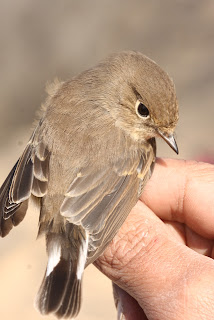
After last weeks Taiga/Rb flycatcher we had a definite Red breasted flycatcher on wednesday morning. the bird had a much lighter bill with the pink underneath covering a much larger area and the rest being more yellowish. the upper tail coverts were clearly lighter than the tail. the tertials showed small white wedges that did not extend into the outer web. the measurements for the two birds were
Taiga/rbf
P2 < wing tip 7.15mm
P2 = P6
P3 and P4 longest
P1 < P2 28.85mm
wing 71mm
tail 55mm
Bill to skull 12 .91mm
bill depth at back of nostrils 3.43mm
RB Flycatcher
P2 < wing tip 5.26mm
P2 = P6
P3 and P4 longest
P1 < P2 28.19mm
wing 68mm
tail 51mm
Bill to skull 12 .56mm
bill depth at back of nostrils 3.19mm
the photographs were taken by chris with his canon but unfortunately did not come out well and do not show the clear differences


Taiga/rbf
P2 < wing tip 7.15mm
P2 = P6
P3 and P4 longest
P1 < P2 28.85mm
wing 71mm
tail 55mm
Bill to skull 12 .91mm
bill depth at back of nostrils 3.43mm
RB Flycatcher
P2 < wing tip 5.26mm
P2 = P6
P3 and P4 longest
P1 < P2 28.19mm
wing 68mm
tail 51mm
Bill to skull 12 .56mm
bill depth at back of nostrils 3.19mm
the photographs were taken by chris with his canon but unfortunately did not come out well and do not show the clear differences


Tuesday, 18 October 2011
Taiga by the tail?
We had a little bit of excitement here on sunday, when after a good mornings catch, Chris, a ringer over here from the US of A doing a post doc, fetched what i first thought was a 1cy red breasted flycatcher out of the bag. i immediateley told him to hand it over as the senior ringer i was not going to let a ringing tick get away from me. So after ringing i began to examine the bird more thoroughly i first noticed the dark bill then checked the tail coverts which were black, excitement was starting to build now, so i rebagged the bird and took it to my house to take photos and make a few calls as i needed more expert help and was soon joined by Barak, Meidad and Yoav. After many photos and a comparison with a bird from the shetlands i was thinking that it was probably a rbf after all as our bird seemed a little warmer in its plumage than the shetland bird.We were joined by Oz in time to release the bird and play some calls in an attempt to entice some voice from it but it promptly disappeared into the gardens. Later that evening however i received an email from Yoav with some very interesting links (which can be viewed at Yoav blog http://nubijar.blogspot.com/ ). After reading them and looking at the photos here i am a lot more optamistic now. But only time will tell and its in the hands of people with a lot more knowledge about this species than me.


Monday, 3 October 2011
When September ends
with september drawing to an end, the migrants started arriving here in much larger numbers and variety. We had a couple of firsts for the plot, i had ringed yellow wagtails around Beer Sheva, but never here, so was nicely surprised when 4 birds were brought to the ringing table. the other new bird was a ringing tick for me, quickly moving the apprentices out of the way when a scops owl was captured. this was my third tick of the month after ringed plovers and curlew sandpipers we had caught when venturing out to Nizzana. Other good birds for the month were 3 1cy ruppels warblers a couple of savis, a great reed, creztchmars bunting, a couple of wryneck, which are always fun to ring, and 11 black eared wheatears. We had only previously had a couple of these birds and always in the spring so to get so many here was really exciting.
the Orphean warblers seem like they have finally come to an end with a grand total of 90 birds of which only 2 were adults


the Orphean warblers seem like they have finally come to an end with a grand total of 90 birds of which only 2 were adults


Subscribe to:
Posts (Atom)